

What did the early church believe about Mary? That’s what we’re going to look at today, but it’s fair to say that each of those terms, “early,” “church” and “believe” are all contested. So, here’s what I mean.
By early, we’re going to look at the time period prior to the Council of Nicaea. Now, I think there’s a lot of misunderstanding about what this council did and didn’t change about Christianity. Books like The Davinci Code by Dan Brown certainly haven’t helped with that. But putting aside those misunderstandings for the moment, I think the Council of Nicaea, which was held in the year 325, serves as a natural point of division in the life of the church.
So, that’s going to be our cutoff for “early” at least in this article. In other articles in this series, we’ll look at what happens after that point.
Saying, “church” is a disputed term might seem strange, but often in historical theology, when we ask, “what did the early church believe?” We restrict “church” to be the people who taught orthodox doctrine. While this might help us get more theologically reliable answers, it doesn’t give us the full picture of what these periods were like, as at any given point, and especially in the early church, there were a wide variety of beliefs from rival groups. So, today, we’ll hear both from church fathers, and non-church fathers, from texts that sit comfortably within orthodoxy, and those that exist on the fringes or resolutely outside the fold.
Finally, “believe.” Sometimes, we take this to just mean, “what was written in theological tomes?” But we should also consider what the church did in addition to what was said or written. This will allows us to look at things like art, liturgy, and devotional practices that we might otherwise miss if we took “believe” to only incorporate those things we write about.
Also, one caveat. For simplicity’s sake, I won’t be discussing the writings of the New Testament today. That’s not because the New Testament has nothing to say about Mary. It’s just to keep our focus on the early church. If you want to learn more about Mary in the New Testament, check out this article. Finally, credit to where it’s due, I’m drawing on several sources here, but I’m deeply indebted to Stephen Shoemaker and his book, Mary in Early Christian Faith and Devotion.
Alright, let’s begin with what is potentially our earliest reference to Mary outside the New Testament, and it comes to us in the apocryphal work, The Ascension of Isaiah.
Ascension of Isaiah (ca. 90 AD)
The Ascension of Isaiah, sometimes also called the Martyrdom of Isaiah is an apocryphal, apocalyptic text that’s been dated by some scholars as early as the late first century. If that is correct, then this would be both our earliest Christian apocrypha, and, more importantly for our purposes, the earliest mention of Mary outside the New Testament.
Now, I should note that dating this text is a little tricky. The manuscript tradition for it is not great, and many scholars believe it’s a composite work, with parts being stitched together from separate works from different times. Nevertheless, it is appears that at least parts of it were well-known from the earliest years of the church.
The text is divided into two parts. The first covers the martyrdom of Isaiah, and the second details Isaiah’s visions of the seven heavens. One of its most distinctive features is recording that Isaiah was sawed in half. Careful readers of the Bible will know that, while the Old Testament never says Isaiah died in this way, the book of Hebrews does. It’s likely that both Hebrews and the Ascension of Isaiah are preserving a common tradition from the period of Second Temple Judaism.
There’s much that could be said about this text, but as it relates to Mary, what’s really important is that this is an early witness to Christian belief in the Virgin Birth. Furthermore, the nature of Jesus’s birth appears a bit strange. According to the Ascension of Isaiah, Mary was only pregnant with Jesus for two months before giving birth, and when she did, it’s free from any labor. Instead, Jesus kind of just appears out of nowhere. Here’s how the text puts it: “It came to pass that when they were alone that Mary straight-way looked with her eyes and saw a small babe, and she was astonished. And after she had been astonished, her womb was found as formerly before she had conceived” (Ascension of Isaiah, 11.8-9). Although this text is short on details, it does seem to correspond with the idea that Mary gave birth in such a way as to preserve the physical signs of virginity in her, a belief known as Mary’s Virgnity “In Partu” which is a critical component of the larger notion of the Perpetual Virginity of Mary, which is a dogma in the Catholic Church. The dogma refers to Mary being a virgin before, during, and after giving birth. “Virginitas in Partu” is a specific reference to that middle idea, remaining a virgin during birth.
Now, I don’t mean to imply that the author of this text had the full dogmatic details of the perpetual virginity of Mary in mind when he wrote the text. He may have, he may not have. What we can at least say from this text is that it bears witness to the fact that some early Christians not only believed that Jesus was born of a virgin, but that the birth itself was highly unusual. While the notion that Mary was only pregnant for two months would not gain much traction in the subsequent tradition, the Perpetual Virginity certainly would.
Note that I said “some Christians.” It’s important throughout this article to recognize that, just because one text shows a belief, it does not mean that all Christians at that time believed the same thing, or that such belief was considered orthodox. We’re getting pieces of the puzzle, but not all of them, and in the earliest centuries, we often have more fragmentary evidence than we’d like simply because there isn’t a ton of material.
Ignatius of Antioch (ca. 110 AD)
So much for the Ascension of Isaiah, let’s now move onto material that I suspect will be more familiar to many of you: the letters of St. Ignatius of Antioch.
Ignatius was a Christian bishop in the late first and early second century. He was martyred in Rome around the year 108-110. We have seven authentic letters from him which were written while he was en route to his martyrdom. They are among the most important works from the early church, and they reveal a remarkably developed ecclesiology and eucharistic theology.
For our purposes though, we can see that Ignatius consistently references that Jesus was born of the Virgin Mary. In his letters, Mary is not necessarily a figure of theological reflection in her own right—that is, very little is said about her specifically—but constant mention is made that Jesus was born of a virgin, and this is used to indicate that he was truly human. At this time, Ignatius was fighting against the Docetists, those who believe Jesus only appeared to be human. But Ignatius insists that Jesus was both truly the eternal son of God and truly a human being, born of the Virgin Mary. For instance, in his Letter to the Trallians, Ignatius makes a point to say that Jesus was “the one of Mary, he who truly was born, both ate and drank” (Ignatius, Letter to the Trallians, 9.1).. You can see this connection between Mary and his humanity here.
Despite the riches of Ignatius’s letters, however, they do not give us much more than this regarding Mary. She was a virgin and the mother of Jesus. Our next writer, however, will begin to develop Mary’s theological significance a bit more.
Justin Martyr
In the mid second century, a philosopher named Justin converted to Christianity, and after his conversion became one of Christianity’s first great apologist, arguing for the rationality of Christian faith against both Jews and Pagans. Around 155-160 AD, St. Justin wrote a work titled, Dialogue with Trypho. In it, Justin is arguing with a Jewish man named Trypho about the truth of Christianity. And it’s here that we have the first depiction of the Virgin Mary as the New Eve. Here’s what Justin writes:
“For Eve, who was a virgin and undefiled, having conceived the word of the serpent, brought forth disobedience and death. But the Virgin Mary received faith and joy, when the angel Gabriel announced the good tidings to her that the Spirit of the Lord would come upon her, and the power of the Highest would overshadow her: wherefore also the Holy Thing begotten of her is the Son of God; and she replied, ‘Be it unto me according to thy word.’” (Justin Martyr, “Dialogue of Justin with Trypho, a Jew,” 249)
This would become a very popular typological interpretation of the New Testament, in which Mary serves as the counterpart to Eve in a similar way to how Christ is the counterpart to Adam. Paul tells us in Romans that all sinned in Adam, but all were made righteous in Christ. Building off this, many Christians made the connection that just as sin began with the disobedience of a woman, redemption began with the obedience of a woman, Mary, who said yes to God.
If you’re interested in a more detailed account of this New Eve typology, I’ve made an entire video on this.
For now, we have a new piece of the puzzle. By the mid-second century, Mary is becoming a figure of theological interest in her own right. Admittedly, it is still fairly restrained interest. Justin does not give us long treatises on Mary, but he is beginning to reflect on her place in salvation history in a new way. Until this point, her role has been displayed as fairly passive, but now we see some reflection on the role of her active obedience to God, which will forever be a hallmark of Marian theology.
If St. Justin Martyr is still somewhat restrained in his thinking, the next work we’ll look at is certainly not.
The Protevangelium of James (ca. 150 AD)
Roughly contemporary with St. Justin Martyr, we find a work known by the title, Protevangelium of James or Proto-Gospel of James. It goes down in history as our first Marian biography and is unique among the works we’ll look at from this period. Thus far, Mary has been exclusively considered in her relationship to Jesus and even then, the focus is narrowed to his birth. Justin expands that field of view slightly to include the Annunciation, but even then we’re not getting a whole lot about the rest of Mary’s life.
The Protevangelium of James firmly breaks with that trajectory. I’ll give you the cliff notes version here, but I do have an entire video devoted to just this text.
Here’s the basic story. It begins with Mary’s parents and her own miraculous birth, followed by her early life. We discover she’s a remarkable child whose upbringing combines the highest Jewish cultic excellence dominated by a focus on keeping her pure. She lives out her live from age 3-12 in the temple, and then after that she is betrothed to Joseph. Except, this isn’t going to be a conventional Jewish marriage. Mary is to remain a virgin and Joseph is to be her guardian. In line with the other texts, she conceives as a virgin by the power of the Holy Spirit, but then the birth is somewhat reminiscent of the Ascension of Isaiah. Here, Jesus suddenly appears with a great light, and much emphasis is placed upon the fact that Mary has remained a virgin during and after giving birth. This is then confirmed by a midwife’s inspection, and as a seeming punishment for doubting Mary’s virginity, the hand she used to inspect Mary’s hymen catches on fire. But, before things get out of hand, the newborn Jesus performs his first miracle by healing the midwife.
While this text would eventually be banned by the western church alongside numerous other apocryphal texts around the 6th century, it was nevertheless a remarkably influential work. Its account of Mary’s early life is the source for later feast days of Mary’s Birth and Entry into the Temple. It was also extremely influential in promoting the idea of Mary remaining a virgin during and after childbirth. Furthermore, its description of Joseph as an older man who had children from a previous marriage provided a critical explanation of who the brothers and sisters of Jesus mentioned in the gospels are.
So great has its impact on the tradition been that one scholar, Stephen Shoemaker, has argued that labeling this as an apocryphal work is somewhat misleading because it is not a work that tried to be canonical and failed but is rather a work that was deeply successful in shaping the tradition. In that respect, he argues that we might call it “quasi-canonical” for many early Christians.
One of the things that’s fascinating about this work, however, is that it extends Marian theology far beyond any of the works that are contemporary with it, or even, as we’ll see, any of the works that come soon after it. Here’s how Shoemaker puts it:
“The Protevangelium stands out significantly amid the diversity of second-century Christianity, particularly for the high esteem it has for the Virgin. Without this text we would have little reason to suspect that Mary had already emerged as a figure of great religious significance for Christians in this era. Yet, by the same token, the Protevangelium’s Marian piety poses a puzzling anomaly that is difficult to relate not only to other elements of second-century Christianity but also to later developments in Marian devotion.” (Stephen J. Shoemaker, Mary in Early Christian Faith and Devotion, 61).
In any case, it offers us a fascinating glimpse into how at least some second century Christians viewed Mary. Unfortunately, we know very little about the community that produced this work, so we can’t say whether they belonged to orthodox or heterodox, but we can at least say that in the East, its traditions became part of the orthodox mainstream of the church.
St. Irenaeus of Lyons (ca. 180 AD)
The next figure I’d like to look at is St. Irenaeus of Lyons, a second century bishop who is best known for his massive work Against Heresies. Much of his life was given to combatting gnosticism, and in so doing, he helped solidify and systematize orthodox Christian doctrine. From the eucharist to the episcopacy and countless topics in between, Irenaeus offers us invaluable insight into early Christian belief. However, the nature of his work as a refutation of heresies also offers a very important glimpse into how heterodox Christians were thinking at the time as well.
And as we’ll see, both the orthodox and heterodox had things to say about Mary.
Very early in his work, Irenaeus relays that some gnostic groups taught that Christ was the son of the Demiurge, the spiritual being who is the fashioner of the fallen material world. These gnostics, we’re told, believe that, “Christ passed through Mary just as water flows through a tube, and there descended upon him in the form of a dove at the time of his baptism, that Saviour who belonged to the Pleroma, and was formed by the combined efforts of all its inhabitants” (Irenaeus, Against Heresies, I. VII. 2).
The relevant idea here seems to be that Mary was a mere instrument of the incarnation, not Christ’s true mother and the source of his humanity.
It’s tempting to read this description of the Gnostic beliefs and see in it a similarity with the type of birth described in the Ascension of Isaiah and Protevangelium of James where Jesus passes through Mary miraculously keeping the physical signs of her virginity in tact. And it’s possible there is a connection here. This is made slightly more plausible by the fact that we don’t see a clear affirmation from Irenaeus on the idea of Mary’s virginity in partu as well as a silence on whether Mary went on to have other children.
However, what strains that reading is that, it would seem that in the previous texts we’ve examined, the miraculous birth is meant to elevate Mary. This is certainly the case in the Protevangelium. But the opposite is the case here. These gnostics are denigrating Mary by reducing her role. Irenaeus’s main concern is that they allege Christ got nothing from Mary. So, using Irenaeus as an argument against the perpetual virginity of Mary is tenuous.
In addition to condemning the notion that Jesus merely passed through Mary, Irenaeus also argues against those who allege that Joseph was truly Jesus’s father. For instance, he attributes to a man named Cerinthus the following belief:
“He represented Jesus as having not been born of a virgin, but as being the son of Joseph and Mary according to the ordinary course of human generation, while he nevertheless was more righteous, prudent, and wise than other men. Moreover, after his baptism, Christ descended upon him in the form of a dove from the Supreme Ruler, and that then he proclaimed the unknown Father, and performed miracles. But at last Christ departed from Jesus, and that then Jesus suffered and rose again, while Christ remained impassible, inasmuch as he was a spiritual being.” (Irenaeus, Against Heresies, I. XXVI. 1).
Here, you’ll notice a theme that runs through many of the heresies that Irenaeus opposes, namely that “Jesus” and “Christ” are not one and the same. Cerinthus says Jesus was born of Joseph and Mary but “Christ” descends upon Jesus at his baptism. If that’s confusing, well, it is, but as a short plug, I’ll note that I did a book club study on Against Heresies with my patrons earlier this year, and if you become a patron, you can access the recordings of those meetings to better understand this fascinating but complex work.
Ok, advertisement aside, in response to these views, Irenaeus fiercely defends the fact that Mary was a virgin when she conceived and that the child she gave birth to was fully God and fully man, the incarnate Word of God.
Here, we can see that, once again, early Marian theology was tightly linked to Christology. The gnostics were content to say that the man Jesus was born of Mary, but not the God-man Jesus Christ. Irenaeus however recognizes that if you get Mary wrong, you’re apt to get Christ wrong too.
In addition to his refutation of these two views of Mary we’ve seen so far, Irenaeus also develops the theme of Mary as the new Eve which we first saw in the writings of Justin Martyr.
In Book 3, chapter 22 of Against Heresies, we find the center of gravity for Irenaeus’s Marian theology, and if you haven’t read it, it’s well worth your time to do so. Here, Irenaeus says, “the knot of Eve’s disobedience was loosed by the obedience of Mary. For what the virgin Eve had bound fast through unbelief, this did the Virgin Mary set free through faith” (Irenaeus, Against Heresies, III. XXII. 4). And thus we get the famous title for Mary, “undoer of knots.”
But it doesn’t stop there. The primary advancement in Marian theology that we find in Irenaeus is not simply a comparison to Eve—after all, we already had that in Justin—instead, it’s the language of Mary being a “cause” of salvation. He writes that Eve “was made the cause of death, both to herself and to the entire human race; so also did Mary, having a man betrothed [to her], and being nevertheless a virgin, by yielding obedience, became the cause of salvation, both to herself and the whole human race” (Irenaeus, Against Heresies, III. XXII. 4).
Now, as I mention in my video on Mary as the New Eve, the word “cause” has many meanings, and following Aristotle, classically we speak of four causes. As it relates to Mary, Irenaeus is saying the Mary is a material cause of salvation, insofar as she gives Christ his humanity, and her active obedience—which is what Irenaeus highlights here—is an efficient cause of salvation, but only secondarily. Christ, of course, is the primary efficient cause. In other words, Mary plays a role, but she is not the savior herself. Nevertheless, even highlighting Mary’s role within the economy of salvation is a significant development in Marian theology at this point.
So, by the end of the second century, the chief doctrinal development we see occurring is a greater appreciation for Mary’s role in salvation history, specifically as a counterpoint to Eve. As sin came through Eve’s disobedience, salvation—in the person of Jesus—came through Mary’s obedient yes to God.
Gnostic Mary
Given the fact that much of Irenaeus’s work consists in arguing with gnostics, it would seem that now is a good time to mention how Mary is portrayed in a few early apocryphal texts beside those mentioned by Irenaeus. I’ll keep this brief as I imagine most of my readers are more interested in the orthodox depictions of Mary. Nevertheless, briefly touching on these gnostic portrayals will help us better get a sense of what kind of ideas about Mary were in circulation in the first few centuries.
One of the difficulties in interpreting these works is that, while they often speak of a woman named Mary, they don’t tell us if they’re speaking of Mary Magdalene, Mary the Mother of Jesus, or someone else entirely. While early scholarship on the gnostic gospels assumed that the figure spoken of was Mary Magdalene, Shoemaker has challenged that thesis and argues that they could just as easily apply to Mary the Mother of Jesus, or, perhaps most likely yet, these figures became fused in early gnostic Christianity.
With that caveat aside, let’s look briefly at three of these texts.
The earliest of these is the Gospel of Thomas which is often dated quite early, to around 90-100 AD. In it, we find Mary being denigrated by the apostles for being a woman, but Christ says that he will personally lead her in order to make her male. This is a bizarre statement that has long confused scholars, but it sets us up for something that will be a theme in these texts: the tension between Mary’s prominence as the mother of Jesus and the difficulty of squaring that with the fact that she’s a woman.
This can be seen clearly in our next text, apocryphal Gospel of Mary, which comes to us from the late second century. Here, we’re introduced to the idea that Mary was entrusted with secret teachings from Christ. Mary as a figure in possession of secret mysteries, or secret “gnosis” is a theme that runs throughout the gnostic gospels. And this makes sense. If your theology is built on the idea that there’s the public revelation that the orthodox community talks about, but then there’s secret knowledge that only your gnostic community knows, it would make sense that, if anyone would be trusted with this secret knowledge, it would be Mary. After all, who would Jesus be more likely to entrust his secrets to than his mother? That, at least, seems to be the basic reasoning of many of the gnostic gospels.
While this is a fairly common theme, there is an additional idea in the Gospel of Mary which makes it stand out. In it, we find some disputes among the apostles over whether it makes sense that a woman would be entrusted with secret knowledge and capable of being a teacher. This book appears to be written, in part, to defend that idea. As Shoemaker writes, “This text seems to comport with other evidence suggesting that women were more accepted as teachers and religious leaders in communities that valued esoteric knowledge as a vehicle for salvation” (Shoemaker, Mary in Early Christian Faith and Devotion, 78). The argument seems to be, if Jesus trusted Mary, and she’s a woman, then why shouldn’t the church trust women to lead as well?
Finally we have a text by the name of Pistis Sophia, likely written during the third century. There, once again, we find tension arising between Mary and Peter. Here, the tension is explicitly linked to Peter’s frustration that Christ is primarily communicating with Mary and not with the rest of the disciples. Insofar as Peter represents the proto-orthodox communities, by pitting Mary against him, it seems the writer is trying to claim Mary for the gnostic cause. Mary has special knowledge they lack.
This is important for our understanding of early Christian Marian doctrine because it might help explain why some of the more orthodox figures of the third century are relatively silent about Mary. If Mary was being held up as the teacher of cosmic mysteries by the heterodox, then the orthodox may have wanted to steer clear.
Tertullian (ca. 160-225 AD)
Turning to the early third century, we find a man named Tertullian, who, despite joining a heterodox group later in his life, was a very influential early Christian figure long after his death. Importantly, his heterodox leanings had more to do with moral rigor than doctrinal deviation, which partially explains why his works remained popular in the West.
In someways, Tertullian follows in the footsteps of Justin and Irenaeus. Like them, he defends the virginal conception and the New Eve typology. However, in sharp contrast with the Protevangelium and the Ascension of Isaiah, Tertullian explicitly rejects Mary’s virginity in partu. Furthermore, he insists that Mary went on to marry Joseph and have other children by natural means with him. Not only that, but Tertullian goes as far as to say that, Jesus rejected Mary based on the passage in Mark where the crowd tells Jesus his mothers and brothers are outside and Jesus responds that his true mother and brothers are those who do his will. For Tertullian, then, Mary is a symbol of unbelieving Jews.
Summarizing Tertullian’s approach to Mary, Stephen Shoemaker writes, “Clearly, in Tertullian we meet the opposite end of the spectrum from the Protevangelium, and not other early church father takes such low view of the Virgin Mary, with the possible exception of John Chrysostom” (Stephen J. Shoemaker, Mary in Early Christian Faith and Devotion, 66). Unfortunately, Chrysostom is outside the time period we’ll look at in this article, but he’s notable for believing that Mary was guilty of sin.
St. Clement of Alexandria (ca. 150-215 AD)
Moving right along, the next Church Father to look at is St. Clement of Alexandria. I should note that whether he should be addressed as “St. Clement” is a disputed matter. The Eastern Orthodox Church doesn’t seem to have a clear answer on this, he’s canonized in the Catholic Church but his feast day was removed from the calendar. However, he is a saint in the Coptic Orthodox Church and the Anglican Churches—which are obviously the best ones—so we’ll go with St. Clement of Alexandria for first reference.
In any case, the main contribution that we get from him regarding Mary is that he explicitly affirms Mary’s virginity in partu, and he does this on the basis of the Protevangelium of James which shows us the significance of this work for at least some writers in the early church.
Building off the point I made early on, it’s important to remember that the early church was not monolithic in its thinking on every point, and the divergences between Clement and Tertullian who wrote around the same time are just one illustration of that. What we want to avoid is selectively quoting one side or the other to say, “clearly the Early Church believed X” when the reality is more complicated.
Origen of Alexandria (ca. 185-254 AD)
Next on the list we have Origen of Alexandria, who really should be St. Origen the Confessor, but, alas, he has been very unfairly maligned throughout church history. That, however, is a matter for another day.
As it relates to Mary, Origen’s views are a bit tricky to pin down, and this is partially because the manuscript history of his works is pretty bad which relates back to his being unfairly maligned throughout church history and having many of his works destroyed.
As it stands, he denies Mary’s virginity in partu in his homilies on Luke but affirms it in his homilies on Leviticus. Given how systematic of a thinker he was, it seems probable that one of these is the result of later scribal changes, but it’s difficult to say which. Either way, it does seem clear that he believed Mary never had sex and was a model of virginity for women.
However, like Tertullian, Origen does attribute faults to Mary, specifically that she doubted at the cross along with the other disciples.
Finally, like Irenaeus, Origen’s apologetic work also helps us see what opponents of Christianity were saying about Mary at this time. In his case, this comes from the work, Contra Celsus. Celsus was a pagan who wrote a polemical work against Christianity in 178 that combined arguments from a number of sources, both pagan and Jewish. About 70 years later, Origen wrote a response to this.
In Celsus’s work, he identifies a Jewish counter-narrative about Mary, that goes like this, “When she was pregnant, she was turned out of the doors of the carpenter to whom she had been betrothed, as having been guilty of adultery, and that she bore a child to a certain soldier named Panterra” (Qtd in Rubin, Mother of God, 14).
It seems that the Protevangelium of James was written in part to respond to claims like these, and it did so by providing a more complete backstory for Mary. As we saw, Clement draws on this in his work, but Origen took a different approach, instead arguing for Mary’s Virginity not only from the New Testament, but also through allegorical readings of the Old Testament, which was a way of debating Jewish opponents of Christianity on their own turf, as it were.
So, while Origen didn’t necessarily move Marian doctrine forward in terms of conclusions, he did open up a new way of exploring Marian doctrine, specifically through the Old Testament. There, the Song of Songs became a special area of focus, and by doing this, he expanded the source material for Marian doctrine. As Miri Rubin writes, “Christian truth was henceforward to be revealed through the inexorable reinterpretation of Jewish Scripture, with the tools of exegesis developed by and for the use of Jews, combined with insights gained from a classical Greek education” (Miri Rubin, Mother of God, 15).
Third Century Fathers Summary
Summarizing the witness of the third century, Stephen Shoemaker writes the following:
“The church fathers of the third century provide disappointingly meagre evidence for the development of Marian devotion in this period. Tertullian offers a surprisingly negative assessment of Mary and her role in earliest Christianity, while Origen and Clement do not add much to what came before them. The church fathers of the later third century, for their part, are inexplicably reticent when it comes to Mary.” (Shoemaker, Mary in Early Christian Faith and Devotion, 96).
However, there is one other piece of evidence we should look at from this time period that could shed a new light on things.
Sub Tuum Praesidium
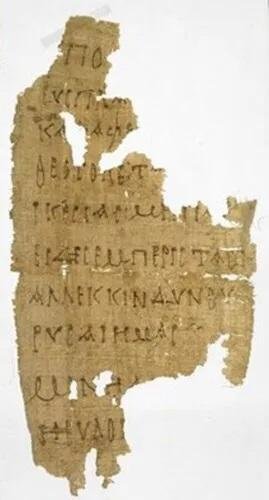
Sub Tuum Praesidium manuscript (John Rylands Library)
Up until now, we’ve seen Mary almost exclusively through a doctrinal lens. The closest we’ve gotten to something like Marian devotion would be the Protevangelium, but even then, we find no sign of belief in Marian intercession, something that will become a hallmark of Marian piety in the centuries to come.
For a long time, scholars believed that the practice of Marian intercession—that is, the practice of asking Mary to pray for us—did not arise in earnest until after the Council of Ephesus in 431. However, that has been challenged in more recent years for a number of reasons. One of the more remarkable pieces evidence against that thesis comes in the form of a small scrap of papyrus known as the sub tuum praesidium.
Discovered in 1917, this fragment of papyrus contains a portion of what would become a liturgical prayer to Mary, which in, Latin, begins with the words sub tuum praesidium which means “beneath your protection.” The text on the papyrus reads: “We take refuge beneath the protection of your compassion, Theotokos. Do not disregard our prayers in troubling times, but deliver us from danger, O only pure and blessed one.”
As we can see, this is pretty clearly a prayer for Mary’s intercession, and the name “theotokos” is significant. There’s some suggestion Origen might have been the first to use this title in the mid 3rd century, but we only have that secondhand. None of his surviving works use the title. So, there’s a chance this is not only our earliest reference to Marian intercession, but also our earliest evidence for the title Theotokos being used for Mary.
However, dating this is really tricky. One thing that apologists on nearly every side often fall prey to is using the earliest possible date for the evidence that aligns with their position and the latest date for evidence that doesn’t align with them. This, however, is not a practice we should engage in.
When it comes to the Sub Tuum Praesidium, you’ll often hear people say that it dates to about 250 AD. This is based on the fact that the initial publication of the papyrus’s finding mentioned that a paleographical expert—that is, someone who specializes in ancient handwriting—was unwilling to date the text later than the third century. The primary editor, however, argued for a 4th century date due to the use of the title “theotokos.”
Often, the discussion stops there. But almost 100 years has passed since then, and things have become less clear. In a 2005 review of the paleographical evidence, Forster argues, “the parallels to the Coptic manuscripts leave a date of the 8-9th century as more probable than the dating of the manuscript to the 2-3, or even the 4th century.”
However, not everyone agrees. Other scholars have, like AnneMarie Luijendijk have maintained the early date. Stegmuller has argued for a 4th century date. And still yet, others side with Forster.
Suffice to say, it appears we currently lack a scholarly consensus on the date, with a range from the 2nd or 3rd century all the way up to the 9th century, and, absent compelling arguments from one side, we should withhold from simply picking whichever serves our purposes. And, for the vast majority of us, myself included, we simply don’t have the necessary expertise to weigh in on a contested matter of highly technical paleographical study.
Nevertheless, I include this papyrus here for two reasons. One, people familiar with these conversations will expect it to be here. Two, though it’s by no means definite that this papyrus belongs to the pre-Nicene period, it is possible that it does. And if it does, it serves as a valuable piece of evidence in reconstructing the development of Marian piety. Specifically, if this papyrus dates from this period, it could be a sign of an emerging Marian piety that was more popular with the laity than the hierarchy of the church, given the fact that this period sees a relative silence on Mary from the Church Fathers.
Mary in Early Christian Art
There’s a famous line from Jesus about the rocks crying out in praise of him if others remain silent. Well, for our purposes, while the third century fathers were relatively silent, perhaps we can see if rocks cry out in the form of art. That’s what we’ll look at now.
Early Christian art was somewhat slow in appearing, and the portrait styles that we now associate with Byzantine iconography pick up steam after the period we’re looking at. However, it would be a mistake to assume that there is therefore no Christian art in this pre-Nicene period. And this art goes beyond symbolic depictions like the fish symbol. As one art historian puts it, “By the fourth decade of the third century, the paintings of the Roman catacombs begin to embrace scenes related to the infancy of the Savior” (F. Bisconti, “The Art of the Catacombs”, in The Oxford Handbooks of Early Christian Archaeology). Much like the early theological writings, early images of Mary focus on her role in the birth of Christ. As Bisconti writes of two early depictions of Mary, “the Madonna is not the true protagonist of the scene but appears as a functional figure in the description of the infantia Salvatoris.” Still, the arrival of Marian artwork in the Roman Catacombs is significant, as it shows that Mary as a devotional figure is growing in stature. The space around which someone is buried is a highly significant space for symbolic purposes, and the entrance of Mary into these spaces is significant.
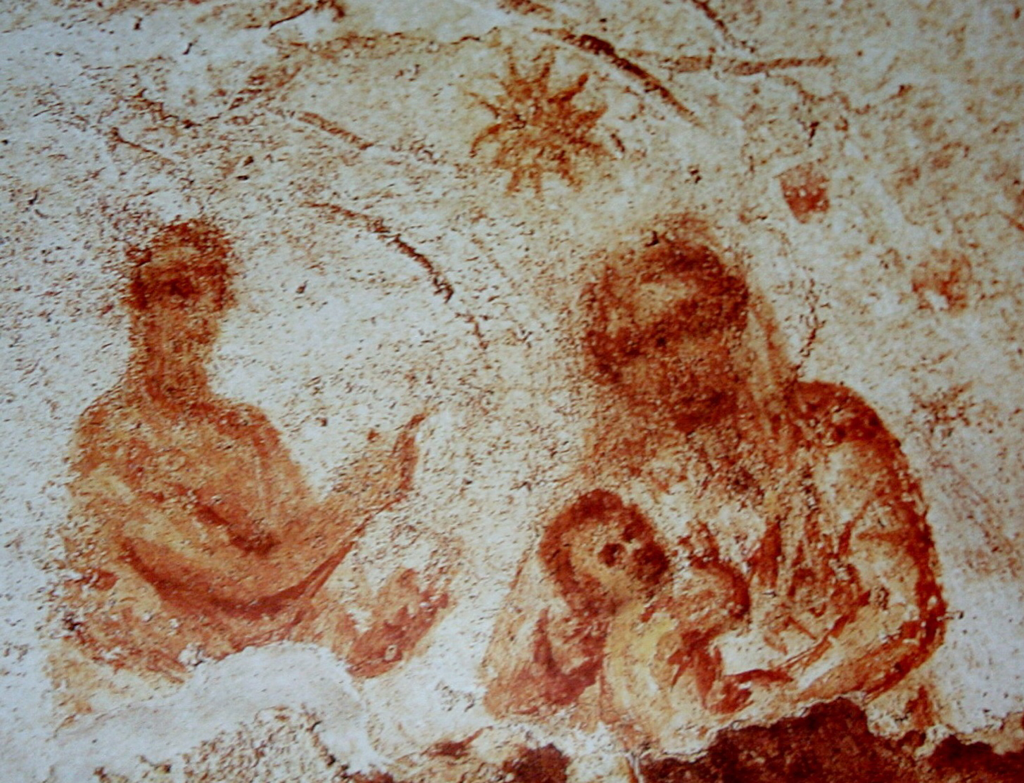
Madonna of Priscilla
Perhaps the earliest image we have of Mary is a fresco known as the Madonna of Priscilla, which likely dates to the third century. It depicts Mary with Jesus on her lap. There has been some debate over whether Mary is breastfeeding Jesus here. Such depictions were popular of Isis and later of Mary in Egyptian contexts, but this catacomb is Roman. Next to her is a star, and a man pointing toward the star who has been described by many scholars as a prophet, perhaps in reference to Balaam or Isaiah or both.
Another potential option for the earliest depiction of Mary comes from the Dura Europos church. If you’re not familiar with it, it’s well worth looking into. In the third century, both a Christian house church and a Jewish synagogue were buried when the Eastern Syrian city was put under siege. As a result of this long time spent underground, when they were discovered in the early 20th century, they offered us something of a time capsule from the third century. What stands out about both the house church, and much more so the synagogue, is the elaborate use of imagery. While the synagogue is more impressive in this remark, the church does offer several images, one of which is a woman at a well. For awhile, this was considered to be the Samaritan woman at the well from John’s gospel, but Dr. Michael Peppard, a previous guest on the Gospel Simplicity podcast, has argued that it may in fact be a depiction of the annunciation, which, in the Protevangelium of James, is said to have taken place at a well. If this is so, it would not only be the earliest datable depiction of Mary, but it would also be another indicator of the impact the Protevangelium had on early understandings of Mary.
Book of Mary’s Repose
The final piece of evidence I’d like to look at from this period comes in the form of an early text about the end of Mary’s life, known as the Book of Mary’s Repose. Now, if you’re interested in a deep dive on the history of belief in Mary’s dormition and assumption, I have a separate video just on that.
However, for today, we’ll just briefly look at this one text. While our earliest manuscript evidence for it dates after the council of Nicaea, Shoemaker has argued based on the theological content of the work that it fits best within the period we’re looking at today.
The reasons for that are a few things. First, it present Christ as an angel, and such angel christologies largely fell out of favor after Christological orthodoxy was established at the Council of Nicaea. Second, Mary is depicted as a figure in possession of secret knowledge, which fits within the emphasis on esotericism that many early apocryphal texts have, like the Pistis Sophia which we looked at earlier. Third, in the text, Mary admits to being scared of dying because she has sinned. While St. John Chrysostom still taught that Mary sinned in the late fourth century, this idea was generally more popular in the time we’re looking at. Finally, the text has a bizarre scene in which Joseph wonders if he might have impregnated Mary one night when he was drunk, which doesn’t fit with the Marian ideas that we see in later centuries.
At first, that might all seem a bit lackluster, like a rather downbeat way to conclude our survey of the early beliefs about Mary. But all of that is just what helps us place it in this period, a period that was full of conflicted ideas. The text also has some really fascinating aspects that depict a high view of Mary as well. As Shoemaker writes, “Yet the Book of Mary’s Repose unquestionably sees Mary’s emergence as a figure of theological significance in her own right and not merely as some Christological annex. And perhaps most importantly, the Book of Mary’s Repose bears early witness to belief in the power of Mary’s intercessions, offering what is seemingly the earliest evidence of this practice” (Shoemaker, Mary in Early Christian Faith and Devotion, 104, emphasis added). What Shoemaker doesn’t mention here but is no less significant is that this is also our likeliest evidence for early Christians believing in the Bodily Assumption of Mary.
Concluding Thoughts
And it’s this bizarre convergence of ideas that makes this, in my opinion, a fitting place to end this survey. The early church was a melting pot of ideas as rival factions sought for dominance. Orthodox and heterodox groups put forward differing visions of the faith, including Mary’s role in the story. Two images might come to mind, depending on how you think about the development of doctrine. On the one hand, the early Christian faith might be like a seed planted in the ground that grows amidst the rocky soil of various heresies and has to compete with these weeds for sunlight, but in time it grows the tallest and strongest and develops into a mature tree. This is essentially the picture St. John Henry Newman offers. Another is more like a series of streams, some of which trickle off, others of which converge to form a strong and wide river. This is more like what David Bentley Hart argues in Tradition and Apocalypse. Whatever image you prefer, what I think we can see through this survey is a story of development. One in which doctrines about Mary are worked out over time as Christianity grows through these tumultuous early periods. And after this period, we’ll see this growth really accelerate in the forms of hymns, liturgies, and treatises on Mary. But those will have to wait for a future piece.
For now, I’m Austin Suggs, and this is Gospel Simplicity. If you’d like to support the work of bringing simplicity out of theological and historical complexity to help people encounter beauty, truth, and goodness in the christian tradition, then consider becoming a patron at patreon.com/gospelsimplicity. To those of you who already support the show, thank you so much. Articles like this would not be possible without your generosity.